How Dogality Test Works: Questions, Scores & Results
Dogality Test turns your answers to 18 behavior questions into four trait scores, then combines those traits into one of 16 dog personality types. You answer based on what you observe; the result is a summary of those answers, with ideas for interaction and play.
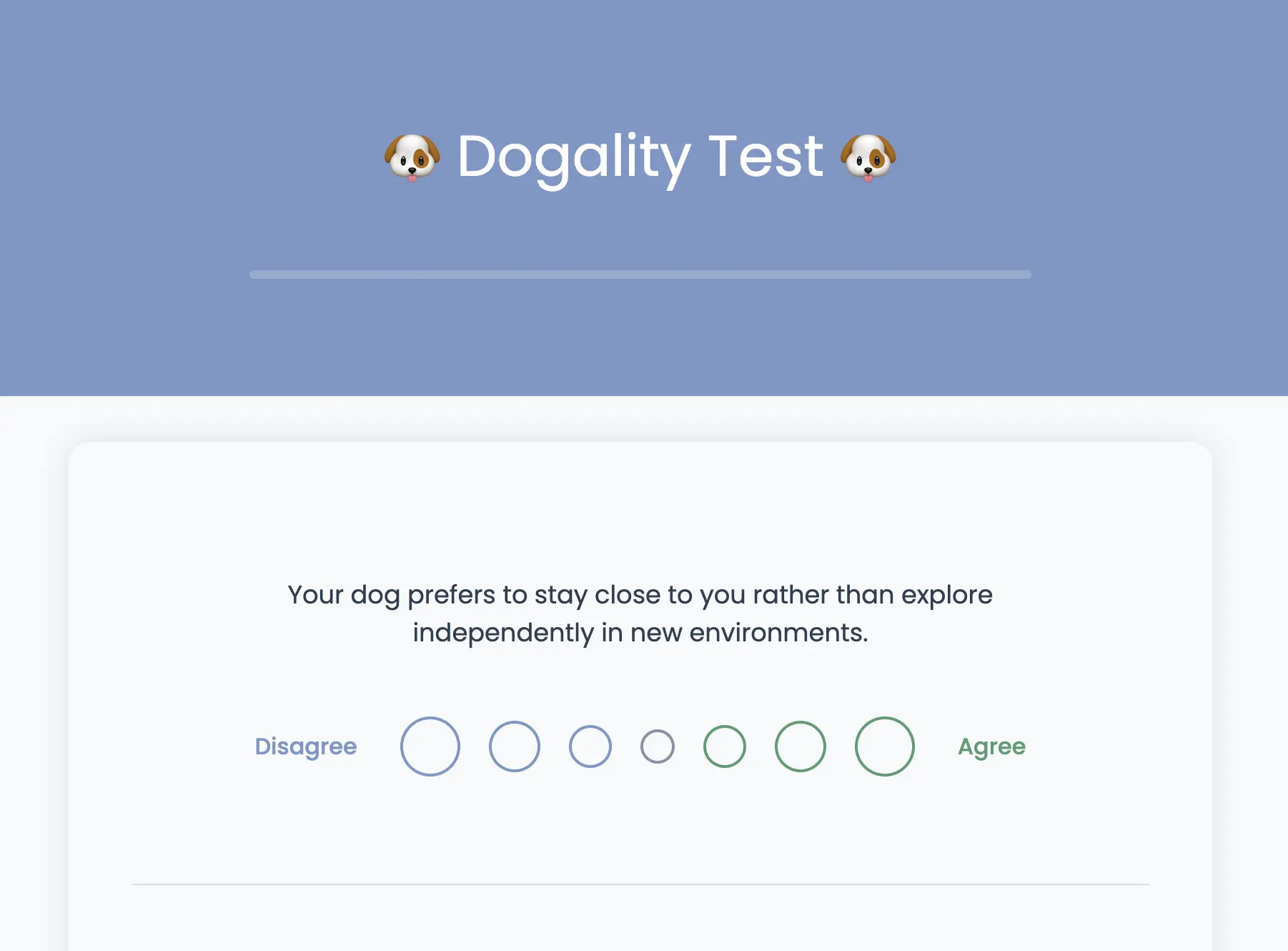
The Quiz in Three Steps
- Answer the behavior questions. Choose how much you agree or disagree with each statement based on your dog's usual behavior.
- Get four trait scores. Your answers are grouped into the four dimensions described below.
- Read your personality profile. The combination of traits selects a type description, interaction suggestions, and toy ideas.
The quiz is free. Allow about 2–3 minutes, or longer if you want to think through your answers. If you are curious about its origin, read why we created Dogality Test.
The Four Dimensions
These are the labels used by Dogality Test. Each pair describes a tendency in your answers, rather than a good or bad quality:
- Dependent ↔ Independent: staying close to you and seeking company, or spending time doing things on their own. Think about ordinary moments at home, such as whether your dog follows you between rooms.
- Cautious ↔ Exploratory: hanging back around something unfamiliar, or approaching to investigate. Think about how your dog usually responds to a new place or object.
- Calm ↔ Excitable: reacting quietly, or responding with more enthusiasm and activity. Think about everyday greetings and play.
- Obedient ↔ Autonomous: following your direction, or pursuing their own choices. Think about familiar requests your dog already understands.
Consider each dimension separately. A dog can enjoy exploring while also staying close to their owner; being independent does not automatically mean being excitable or autonomous.
From Scores to 16 Types
Each answer carries a score. The quiz adds the scores within each dimension and expresses the total on a 0–100 scale relative to that dimension's maximum possible score. It uses the midpoint to choose a side of each pair, then combines the four choices. Two sides across four dimensions give 16 possible combinations.
The percentages are quiz scores, not probabilities or comparisons with other dogs. For example, a score of 60 toward Exploratory does not mean your dog explores 60% of the time or is more exploratory than 60% of dogs.
A score near the midpoint represents answers closer to the center of that scale. A small change in answers can move it across the type boundary, so two dogs with similar scores may receive different type labels. Read the four bars alongside the label for a fuller picture.
How to Choose Your Answers
- Use a recent, typical example. Think about an ordinary day, rather than the single most memorable incident.
- Answer for the dog you observe. Choose what fits now, not what you hope training will eventually achieve.
- Consider the situation. If your dog acts differently at home and outside, think about which response is more usual for the situation in the question.
- Allow for uncertainty. If you have only just met or adopted your dog, spend more time observing before treating the profile as a useful summary.
For example, a dog might approach a familiar visitor but hang back around strangers. When answering a question about unfamiliar people, use the second situation. You do not need to arrange an encounter just to answer a question. Our article on what dog walks uncover offers more everyday situations to observe.
How to Read Your Result
Start with the four trait bars, then read the type description. Ask yourself which parts match what you regularly see and which do not. The interaction and toy suggestions are ideas to consider, rather than instructions every dog of that type must follow. The fun career suggestion is playful. You can also browse all 16 personality types to compare the descriptions.
Dogality Test is inspired by MBTI's idea of personality types. It is not a scientifically validated canine assessment, a measure of intelligence, or a veterinary diagnosis. It does not establish the cause of a behavior or guarantee a training outcome. Use the profile for reflection, and let your dog's actual responses guide what you try together.
Take the Quiz
Ready to put your observations together? Take the free Dogality Test, then compare the profile with your own examples of your dog's behavior.
FAQ
Does breed determine the personality type?
No. The personality type is calculated from your answers to the behavior questions, rather than assigned from your dog's breed.
Why might I get a different result when I retake the quiz?
Different answers produce different scores. A small shift near a dimension's midpoint can also change the type label. Compare the trait bars and the situations you had in mind, rather than assuming one label is definitive.
Can I answer for more than one dog?
Complete a separate quiz for each dog. Combining observations of different dogs would not describe either one clearly.